If you were the victim of a hit-and-run (otherwise known as a “hit-skip”) in Marion, you may be asking whether you have a case at all. In many of these crashes, your claim is filed against your own insurance policy rather than the at-fault driver who fled. But to do so, you must be able to show, with something more than your own account, that another vehicle caused your accident.
A hit-and-run accident lawyer can help you manage your claim and help you investigate your hit-and-run, guiding you through each step of the legal process. You can contact The Fitch Law Firm today at (740) 212-1686 to learn more about how we can help accident victims like you.
What Ohio law requires you to prove
Ohio law recognizes an unidentified driver as an “uninsured motorist,” which means that, in the case that the at-fault driver is never found, your pathway to recovering compensation will be through the uninsured motorist (UM) coverage on your auto policy.
But this pathway is only accessible if corroborative evidence exists proving that the unknown driver caused your injuries. Such evidence must consist of more than just your personal account, as the law does not take your testimony alone as valid and adequate evidence.
However, supporting evidence derived from your testimony may be accepted thanks to the Ohio Supreme Court’s 2016 ruling in Smith v. Erie Insurance Company. When an Ohio couple was run off the road in a no-contact accident, their insurance company refused the police report and medical records (which recorded their testimony) as adequate additional evidence. But the Supreme Court found that the ambiguous wording in the insurance policy would accept such forms of documentation as the “additional evidence” required for their claim.
This holding can play a significant role in Marion County, where a large share of crashes can happen on two-lane state routes and township roads late at night, where witnesses and video footage may be sparse.

What counts as corroborating evidence in a Marion crash
The evidence needed to make a hit-and-run claim may be more mundane and that some people think, but it can also be time-sensitive. Physical evidence in particular may not be available after a certain amount of time has passed.
If you were the victim of a hit-skip accident in Marion, the following forms of evidence can be submitted to support your claim:
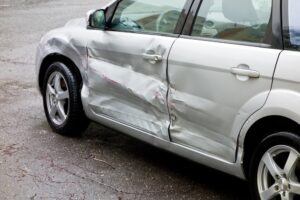
- Transferred paint or foreign debris on your vehicle
- Damage geometry inconsistent with a single-vehicle crash
- Roadway evidence such as skid marks, gouges, scattered parts, a broken mirror housing or grille fragment left in the road
- The crash report and the responding officer’s scene observations
- Emergency room records documenting a mechanism of injury consistent with your account
- Any 911 recording, which timestamps your description before you had time to construct one
- Third-party video, which is highly valuable but may also disappear quickly

The Last Thing You Should Worry About Is How You’re Going To Pay For Your Medical Bills.
 (614) 545-3930
Where the video is in Marion and how long you have
Most private surveillance systems overwrite on a loop (the most common range is 30-90 days), but some businesses or smaller properties may rewrite in only a few days.
A letter asking a business to preserve footage costs nothing, and when sent two days after your accident, it can often be granted. Sent twenty days after, however, may not be as easily achievable.
Where to look for footage depending on the location of your accident:
| Marion corridor | What may be there |
| Barks Road retail strip | Big-box and shopping-center parking lot and entrance cameras, often multi-angle. |
| Downtown — Center Street, Main Street, Courthouse Square
|
Storefront and municipal building cameras; short retention on small-business systems.
|
| Mount Vernon Avenue (SR 95) | Commercial frontage as well as the OSU Marion / Marion Technical College campus. |
| Delaware Avenue, Prospect Street, or State Street (SR 4 & 423) | Gas stations, drive-throughs, and bank ATM cameras |
| Industrial corridor and Marion Municipal Airport area | Plant gate and perimeter cameras; useful because shift changes put dense, predictable traffic on these roads at fixed hours. |
| US 23 and rural SR 98 / SR 529 | Little fixed camera coverage; residential doorbell cameras and dash cams become the realistic source. |
A research brief published in 2026 by the AAA Foundation for Traffic Safety found that over 70% of hit-and-run drivers crashed within 10 miles of their home. That means that in Marion — a compact grid with a handful of arterials — the chances of finding the at-fault driver are higher than they would be in a larger, more dense metro area. A vehicle with fresh front-end damage that left a scene on Delaware Avenue is statistically likely to be sitting somewhere within a few miles of it. Canvassing local body shops, neighborhood streets, and residential camera owners in the immediate area can be an impactful investigative step in finding the hit-and-run driver who harmed you.
The first 72 hours: what to do
- Call 911 from the scene, even if the other car is already gone. The report is often the foundation of your corroborating evidence.
- Write down everything you can recall while it is fresh — color, body style, direction of travel, any partial plate, damage you saw on the other vehicle.
- Photograph your vehicle before any repair, including paint transfer, close-up damage, and the scene itself.
- Get medical evaluation the same day. An adjuster may use gaps in to reduce a claim.
- Note which agency responded. Marion Police Department for city streets, the Marion County Sheriff’s Office for township roads, or the Ohio State Highway Patrol for US 23 and state routes outside the city. Each keeps its own records.
- Request the crash report through the Ohio Department of Public Safety crash retrieval system; Marion PD also maintains a public records portal.
- Send preservation letters to nearby businesses immediately.
- Report the crash to your own insurer promptly. Most policies contain a notice condition, and late notice is a common denial basis.
We Will Be
There To Help
You All The Way
Do you have uninsured motorist coverage?
Ohio does not require uninsured motorist (UM) insurance to be included in your auto policy, which means that some Marion drivers may not know whether it’s part of their coverage until they need it.
If you aren’t sure what your policy includes, you can find your declarations page, which summarizes your insurance details and active coverages.
If you find out that you do not have UM coverage but may already be in a position where you need it, check whether the policy of a resident relative’s (i.e. a relative who lives in the same household as you) might apply.
Your own insurer is not on your side in a UM claim
Many drivers may not expect this, but your insurance company will evaluate your accident claim as if they are defending the driver who fled. They might argue that the phantom vehicle never existed, that your injuries came from something else, that your treatment was excessive, and that your damages are worth less than you say.
You are, functionally, adverse to your own carrier.
You may have multiple deadlines
Accident victims generally have two years to file an accident claim and pursue accountability from negligent drivers who harmed them. But other processes and post-accident needs don’t always share the same timeline. The following are a few time windows that you might want to keep in mind:
| Deadline | Governed by | Typical window |
| Notice to your own insurer | Your policy’s notice condition | “Prompt” (within a couple days) |
| Injury lawsuit against an identified driver | ORC § 2305.10 | Two years from the crash |
| UM claim against your insurer | Contract law and your policy’s limitations clause | Varies by policy; generally three years in Ohio (exceptions apply) |
| Wrongful death claim | ORC § 2125.02 | Two years from death |
| Evidence preservation (video) | Nobody’s law — the vendor’s settings | Often 7–30 days |
Common misconceptions
“There was no contact, so I have no claim.”
Not true. Just because the driver that caused your accident did not make contract with your car does not mean that you don’t have a case. Ohio recognizes phantom vehicle accident claims (as we know from the Ohio Supreme Court ruling on Smith v. Erie).
“There were no witnesses, so I have no claim.”
Not necessarily. Smith held that a police report and medical records based on your own account can supply the required additional evidence.
“It happened in a parking lot, so it doesn’t count.”
ORC § 4549.021 covers private property, and your UM coverage does not stop at the curb.
“My own insurance will just pay.”
Your insurer will investigate the claim the way the fleeing driver’s insurer would have. They are not likely to have your best interests in mind.
“If police catch the driver, my claim goes away.”
False. Some of the elements of your case will change, but it doesn’t simply go away. You will pursue that driver’s liability coverage, and your UM carrier may assert subrogation (reimbursement from a third party) for what it already paid.
“Filing on my own policy will raise my rates.”
This is not necessarily the case. There is a good chance that if you were not at fault for the hit-and-run, then your insurance rates are not likely to rise. A not-at-fault claim is treated differently from an at-fault claim, but the specifics depend on your carrier and policy.
How The Fitch Law Firm can help you
Our legal team understands how difficult it can be to navigate the claims process after you’ve been in a stressful and traumatizing car accident. The Fitch Law Firm has decades of experience that we can draw on to take care of the legal legwork for you.
To help alleviate some of your burden, our legal team can:
- Investigate the hit-and-run collision
- Help gather police reports and other relevant evidence
- Work with medical professionals to document injuries
- Handle uninsured and underinsured motorist claims
- Negotiating with insurance companies
- Identify liable parties
- Assess your potential recoverable damages
Let us handle your legal needs so that you can focus on getting your health and life back.
Talk to a Marion hit and run lawyer
Seeking legal consultation sooner rather than later can have a positive impact on your claim and make gathering evidence and investigating your accident easier. Don’t wait until footage is overwritten and memories have faded.
You can reach out to The Fitch Law Firm now for a free consultation to learn more about your legal rights after a hit-and-run accident. Because our attorneys believe in making justice more accessible, our clients pay nothing unless we’re able to recovery compensation for them.
You can call us at (740) 212-1686 or reach out through our contact form. Se Habla Español.